Inference engine optimization
Coordinate continuous batching, parallelism and execution around real traffic.
Lower wait · raise useful throughput

Uptech API unifies inference engines, tiered KV cache and GPU scheduling in one production pipeline—continuously improving wait time, throughput and resource utilization while keeping endpoints stable.
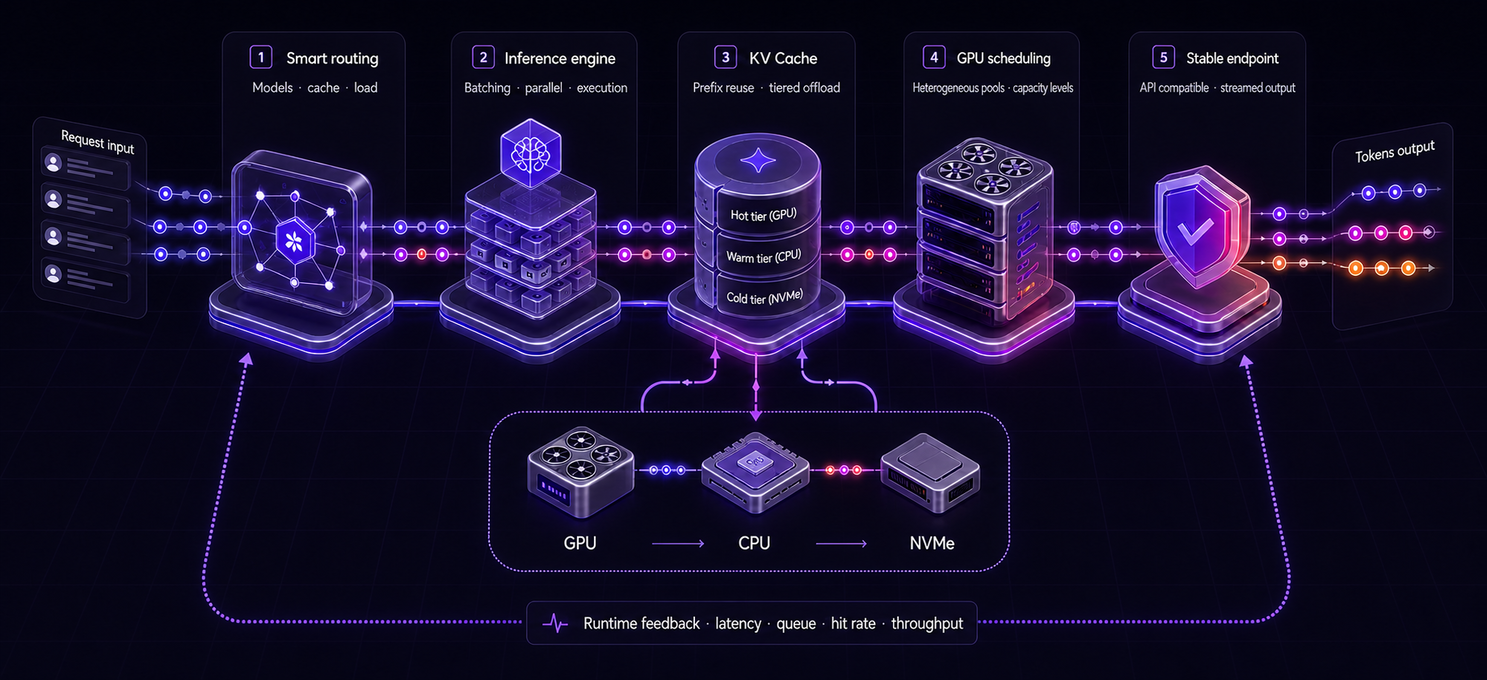
Token Factory brings request paths, cache tiers, compute capacity and runtime feedback into one continuously optimized control plane.
Coordinate continuous batching, parallelism and execution around real traffic.
Lower wait · raise useful throughputReuse eligible prefixes across GPU, CPU and NVMe to reduce recompute and memory pressure.
Improve reuse · free GPU memoryMatch model scale, context and concurrency to the right heterogeneous GPU pool.
Reduce idle time · avoid hotspotsContinuously tune routing and capacity with latency, throughput, cache and utilization signals.
Continuously tune · serve reliablyMarket research context: hardware represents roughly 80% of token production cost. Actual cost and optimization gains depend on the model, hardware and traffic profile; this is not a performance, pricing or SLA commitment.
Verified against official open-weight releases on Aug 18, 2026. These configurations guide early capacity planning, not live availability or performance guarantees.
Qwen3.8-Max adds managed features on top of these open weights.
FP8 weights; reserve KV cache separately for full context.
Scale to multiple nodes for long context or production throughput.
MXFP4 weights and MXFP8 activations; plan for multiple nodes.
Native BF16 weights; production concurrency needs more headroom.
For MoE models, active parameters shape per-token compute, while total weights, KV cache, precision and concurrency determine real memory needs.
Low-precision frontier MoE weights can start on a high-memory node.
Qwen3.8 · DeepSeek-V4-Pro-0813Mixed precision reduces weight memory; production loads still need validation.
MiniMax-M3For large total weights, fast interconnects and planned capacity.
GLM-5.2 · Kimi-K3Capacity estimate, not an SLA. Minimum loadability is not stable serving; validate precision, inference engine, context, concurrency and network topology for your workload.
A look at the experience we are building: choose a model, configure compute, let Uptech API deploy it, then connect the endpoint to your app.
Browse leading open models and choose the right fit.
We provision, optimize and manage your dedicated compute.
Integrate via OpenAI-compatible APIs and start building.


